Ali Moghimi's PhD Defense Seminar Announcement
February 5, 2019
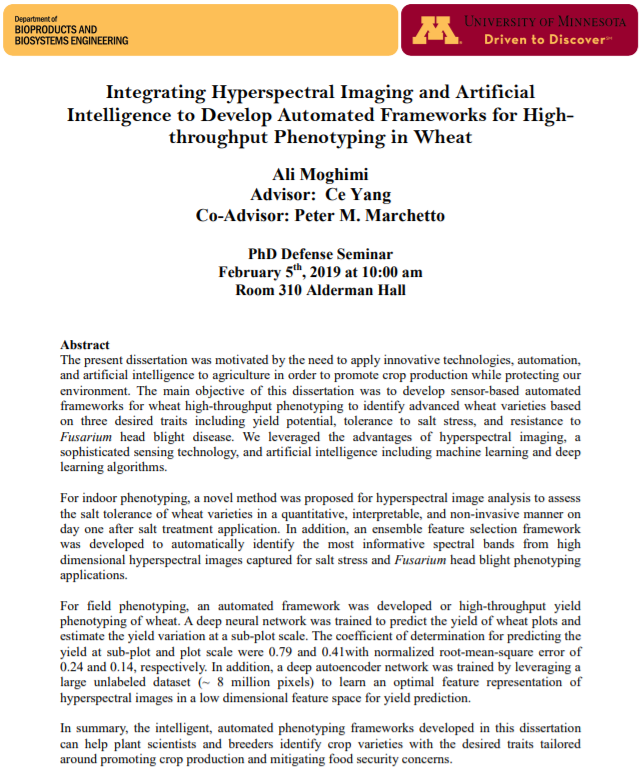
The Department of Precision Agriculture is excited to announce the PhD defense seminar of Ali Moghimi, scheduled for Tuesday, February 5, 2019, at 10:00 AM in Room 310 Alderman Hall. Ali will present his groundbreaking dissertation titled:
"Integrating Hyperspectral Imaging and Artificial Intelligence to Develop Automated Frameworks for High-Throughput Phenotyping in Wheat."
Abstract for Dr. Ali Moghimi's Ph.D. Defense
The present dissertation was motivated by the need to apply innovative technologies, automation, and artificial intelligence to agriculture in order to promote crop production while protecting our environment. The main objective of this dissertation was to develop sensor-based automated frameworks for wheat high-throughput phenotyping to identify advanced wheat varieties based on three desired traits including yield potential, tolerance to salt stress, and resistance to Fusarium head blight disease. We leveraged the advantages of hyperspectral imaging, a sophisticated sensing technology, and artificial intelligence including machine learning and deep learning algorithms.
For indoor phenotyping, a novel method was proposed for hyperspectral image analysis to assess the salt tolerance of wheat varieties in a quantitative, interpretable, and non-invasive manner on day one after salt treatment application. In addition, an ensemble feature selection framework was developed to automatically identify the most informative spectral bands from high-dimensional hyperspectral images captured for salt stress and Fusarium head blight phenotyping applications.
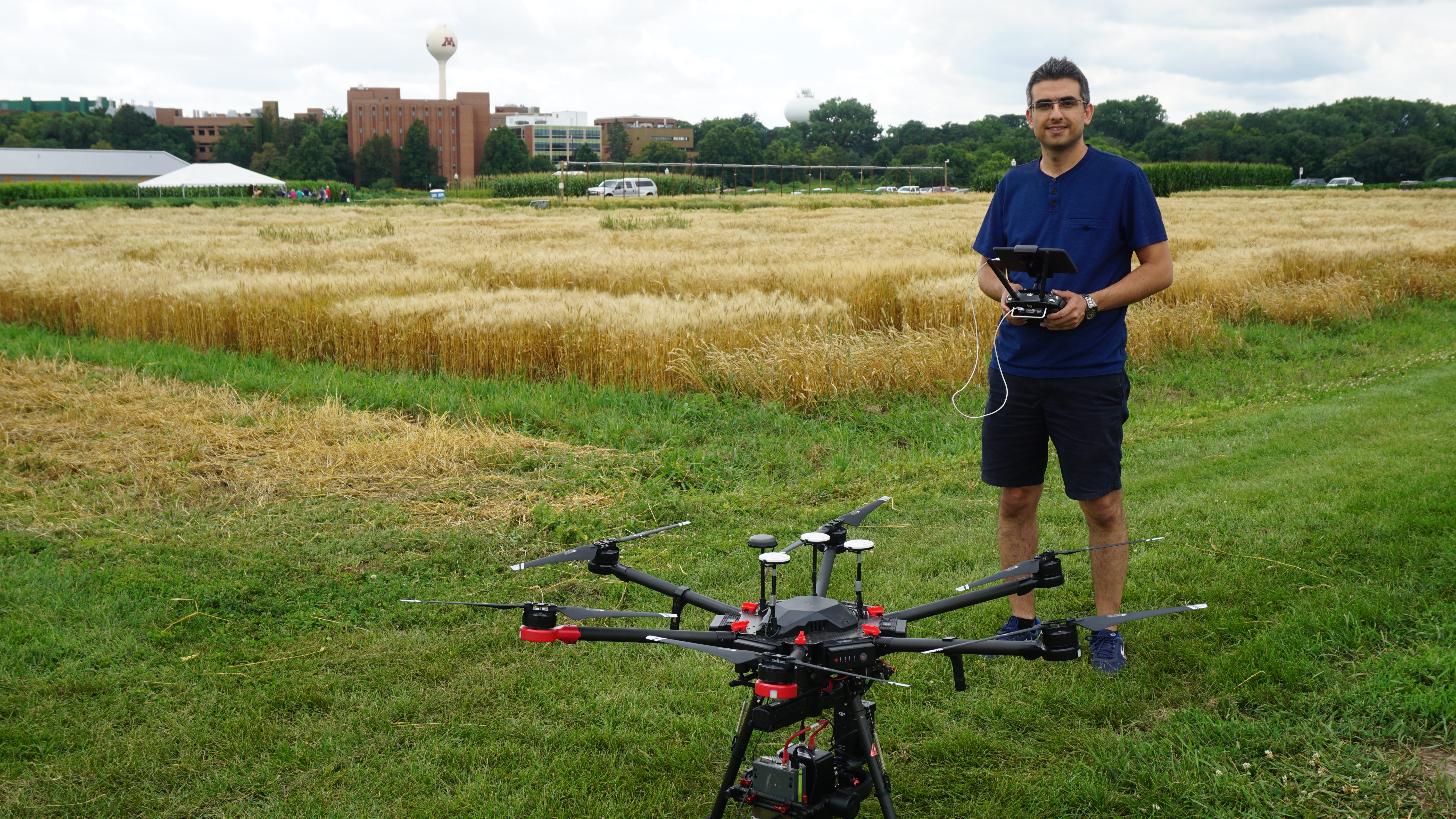
For field phenotyping, an automated framework was developed for high-throughput yield phenotyping of wheat. A deep neural network was trained to predict the yield of wheat plots and estimate the yield variation at a sub-plot scale. The coefficient of determination for predicting the yield at sub-plot and plot scale were 0.79 and 0.41 with normalized root-mean-square error of 0.24 and 0.14, respectively. In addition, a deep autoencoder network was trained by leveraging a large unlabeled dataset (~8 million pixels) to learn an optimal feature representation of hyperspectral images in a low-dimensional feature space for yield prediction.
In summary, the intelligent, automated phenotyping frameworks developed in this dissertation can help plant scientists and breeders identify crop varieties with the desired traits tailored around promoting crop production and mitigating food security concerns.
We wish Ali the best of luck during his defense!